Springtime recently arrived where I live, with an abundance of dandelions to enjoy. That’s the operative word, “enjoy”! Fresh or dried (and for the roots, roasted), you can’t make dandelion tea the wrong way. Find out your preference. Roasting gives the roots a “coffee” flavor, and a great season to harvest them is autumn, if that’s what you have where you are now. Most of the time I use the roots, leaves, and flower blossoms for tea fresh, just add simmering hot water to the cleaned plant. Of course, fresh has its own taste; find what works best for you. Sometimes it’s worth it to go to the extra steps to achieve a certain taste; other times, “quick and easy” works just fine. Use the plant however you wish, “it’s all good”: raw or roasted, finely chopped or… sometimes I use hot water to extract some of the goodness on the whole entire plant (not chopped), and then eat the cooked plant afterwards. Lots of sauces dress up the dish if you don’t want it plain. Yesterday, for instance, Hollandaise sauce made a great topping. I would love to hear your favorites! I have dried leaves on a window screen and also have used a dehydrator. For many thousands of years before dehydrators, people have loved eating dandelions! And they each can share their favorite recipes! One fun thing you might like is to ask people and see what they say! I did that yesterday and heard about “wilted dandelion salad” with mushrooms. Included in the feedback will perhaps be stories from childhood or previous generations. You might discover a treasure trove! And I would love you to write and share! Ruth
Thanks to Canadian singer Allan Rankin for granting permission to use his song for the video, Don’t Kill the Dandelion. Allan Rankin is a Prince Edward Island singer-songwriter, former senior public servant, and writer. Over a career spanning more than thirty years, Allan held senior positions in the provincial government, and also worked as a policy adviser in Ottawa. Be sure to check out his website.. http://www.theislandheartbeat.com/
Would you like a cup of dandelion tea? Well, does the cup come with a dandelion pattern? And how about your tablecloth, placemats, napkins? Do you know a company called Dandelion makes eco-friendly dandelion blossom yellow forks, spoons, and bowls? Dandelions decorate the world in many ways. Smile – and discover your favorites!
We strive to bring you all family-friendly things dandelion on these pages, and hope you return to browse – and shop, if you like, and we hope you do – often!
When I bought my Nokia cell phone, the first thing I did was choose this dandelion picture as the wallpaper:
Posted on January 19th, 2013 by ruth and filed under Other Uses for Dandelions|Comments Off on Dandelions Everywhere!
Form English (or Australian!) words from “dandelion tea”? Use no abbreviations, no proper nouns or pronouns, no improper words, no informal alternate spellings (like nite for night), and no slang. All the letters, organized for your convenience: consonants: d d l n n tvowels: a a e e i o
How many words can you make in 1 minute? Take the challenge & play! Answers:
A A: a (ad) add addle ade aid aided ail ailed ale alit alone alto an anal and annal anneal anoint anointed anon ant ante anti at ate atone atoned
D D: dale dandelion dead deaden deal dealed deed del [vector differential operator] (deli) delta deltoid den denote denoted dent dental dented dentin dial dialed did die died diel diet dit dite dited dine dined do doe don donate donated done donned dot dote doted dude [ranch] dun dune
E E: eat eaten edit edited eel el elated elation eld elite ell end ended entail entailed eon
I: id ide [fish] idea ideal idle idled in inane indeed indolent inlet inn innate ion iota it
L: lad laden laid lanate land landed lane laned late lateen latin lead leaded led lei lend lended lent let lid lie lied linden line lined lint lion lit load loan loaned lode loden loin lone lot lotion lotioned
N N: nada nail nailed nat nation national neat neaten need neon net nil nit no nod node noel non none not note noted
O: oat odd ode oil oiled oint old olden (oleo) on one
T: tad tail tailed tale talon tan tanned tea teal te [note] ted tee teed teen teil [tree] ten tend tendon tenet ti [note] tiddle tide tided tidal tilde tile tiled tin tine tined tinned toad toddle toil toiled told ton tonal tone toned tonned
Try making a sentence—or phrase—or two, if you like! It landed and no one noted it. … a tail on a lion …a dial tone...
Phrases using each dandelion-tea letter once: nation dealed;national deed…
We hope you add to our dandelion-tea word game and welcome your comments!
Posted on July 22nd, 2009 by ruth and filed under Other Uses for Dandelions|Comments Off on Word Game – Dandelion Tea
Eighth Most WantedWHAT? Summer Brew! Whew! The news reports that Fantôme Pissenlit, from Belgium, is actually a very good beer. I personally would not know, although I loved visiting Belgium; I do not drink beer, but my husband does—ask him! Why beer on a tea site? This beer is made from… you guessed it! …dandelion tea!!!
In a Jul 15, 2009 post in Inventor Spot, Serious Fun for the Inventor in All of Us, “Don’t let the fact that dandelion tea is the basis for the Pissenlit, which is usually made with barley malt and hops. ( ‘Pissenlit’ means ‘piss in the bed’ in French, and uncooked dandelions are said to have a diuretic effect.) A peppy Belgian brew that pours amber, the flavor is described as acidic or very citric, depending on the reviewer. Orange makes a strong appearance as does spice.”
Come springtime, workers get to harvesting bushels of dandelions from the fields around the scenic farmhouse brewery. They remove the yellow flowers to dry in the sun, and then soak them a few days in water. They ferment the thick, dark dandelion “tea” and transform it into Pissenlit, a traditional drink also made from barley malt and hops. The result resembles a classic saison ale: golden and spritzy, strong and flavorful, having a distinctive hop bite. Even if it’s a strain to taste the brewed dandelion tea, it’s definitely in there in the bottles.
Gives a whole new meaning to “tea time”!
Beer is a beverage imbibed countless thousands of years. Noteworthy side effects can include addiction to alcohol; as always, keep on the proper side of the law, and concerning participating in this popular pastime, proceed at your own risk.
Posted on July 15th, 2009 by ruth and filed under Other Uses for Dandelions|Comments Off on Dandelion: Eighth MOST WANTED in the World
I wanted a cup of dandelion tea. Sounded sweet and simple, until I wondered if I preferred tea made from the blossoms, leaves, or roots—the roots roasted, or not.
Reminded me of the foreigner arriving in New York City, not knowing a word of English, getting hungry. He formulated a plan: follow someone into a restaurant, and if what they ordered looked good, try ordering the same thing himself. Things went quite well, as he listened to the folks ahead of him order bean soup; it looked appetizing, and smelled good. “What will you have?” “Bea-n Sou-p, pl-ease!” He enjoyed eating it that meal… and ordered it the next meal, and the next. Now he wanted anything but bean soup. He got in line, unknowingly behind regulars — who placed a ham sandwich order. He didn’t understand a word anyone said, and waited to see what showed up. The sandwich looked very appetizing, and a whole lot different from bean soup. When it was his turn, he repeated in his best English, “Ha-m Sa-nd-wi-ch, please!” “Plain or rye?” “…??? … ??? … … Bea-n Sou-p, please.”
Blossoms? Leaves?? Or, roots??? Well, I made dandelion tea using the whole plant!
Posted on July 13th, 2009 by ruth and filed under Other Uses for Dandelions|Comments Off on Dandelion Tea Prose
Dandelions belong to the big sunflower family Asteraceae (formerly Compositae), along with over 10% of the world’s flowers. Blossoms are organized into an involucrate pseudanthium in the form of a head (or capitulum). This immediately recognizable characteristic-even from a distance-makes dandelions and their relatives the easiest, and possibly largest, family of flowering plants to identify.
The successful floral configuration surprises almost everyone; indeed, a dandelion is not simply one flower, but perhaps a hundred. Each flower makes a dry-seeded fruit (an achene) attached to a downy parachute, forming the fluffy white puffball every child likes to blow away into the wind (and then make a wish).
Composite blooms are mostly two types of flowers: ray flowers (outer “petals”, as pulled off a daisy, “…loves me, loves me not…”) and disc flowers (inner center, like the “eye” in Black-Eyed Susans). This exclusive asteraceous inflorescence likely ensures being the best-represented plants in any chosen backyard.
Dandelion relatives include herbs, shrubs, and some trees, food and ornamental plants such as:
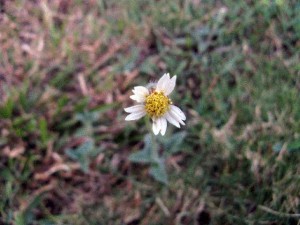
With Kevin’s Low’s kind permission, we will show you here his photographs of a dandelion relative (white ray flowers as “petals” surrounding yellow disc flowers clumped in a central cluster) that is “growing wild all over the place” in Malaysia:
We look forward to learning the name of this plant and if it is edible/medicinal, perhaps like chamomile tea… If you know, please write us your comments! Thanks! We look forward to hearing from you!
Posted on June 3rd, 2009 by ruth and filed under Other Uses for Dandelions|Comments Off on Some “Relative” Comments on Dandelions
Common activities children like to do with dandelions include plucking a bright yellow blossom and holding it under someone’s chin “to see if they like butter”, and forming a golden crown, necklace, or bracelet by making a cut in one flower stalk and inserting the blossom of different flower stalk into it, one after another.
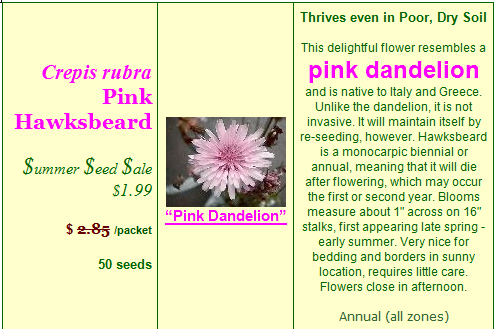
A folk name for dandelion, yellow gowan (gowan: yellow kind of a common daisy) refers to the blooming dandelion’s bright golden yellow. Is there any other color?
Click the Pretty Pink to order these dandelion relatives.
Posted on June 1st, 2009 by ruth and filed under Other Uses for Dandelions|Comments Off on “Tickled Pink” to Find a Dandelion